

















Veja «A resistência à água explicada»
Cariette Technical Guide
Watch Water Resistance Explained: Everything You Need to Know
Decoding ATM, Bar, and meter ratings to protect your timepiece and match your lifestyle with precision.
Water resistance is one of the most misunderstood specifications in horology. A number engraved on the case back does not tell the full story. At Cariette, we believe every collector deserves to understand the engineering behind their timepiece — so you can wear it with confidence, from boardroom to ocean floor.
Water Resistant, Not Waterproof
The term "waterproof" is legally prohibited by the Federal Trade Commission. No watch is truly waterproof under all conditions. Water resistance indicates how much pressure a watch can withstand in controlled laboratory testing — static pressure, at a specific temperature, for a limited duration. Real-world use introduces dynamic forces that can exceed these ratings significantly.
Understanding the Measurements
Manufacturers use three interchangeable units to express water resistance. They are mathematically equivalent but appear differently across brands and regions.
ATM
Atmospheres — a unit of pressure. 1 ATM equals the air pressure at sea level.
Bar
Metric pressure unit. 1 Bar = 1 ATM exactly. Used primarily by European manufacturers.
Meters
Equivalent water depth. 10 meters = 1 ATM. A theoretical depth, not a diving recommendation.
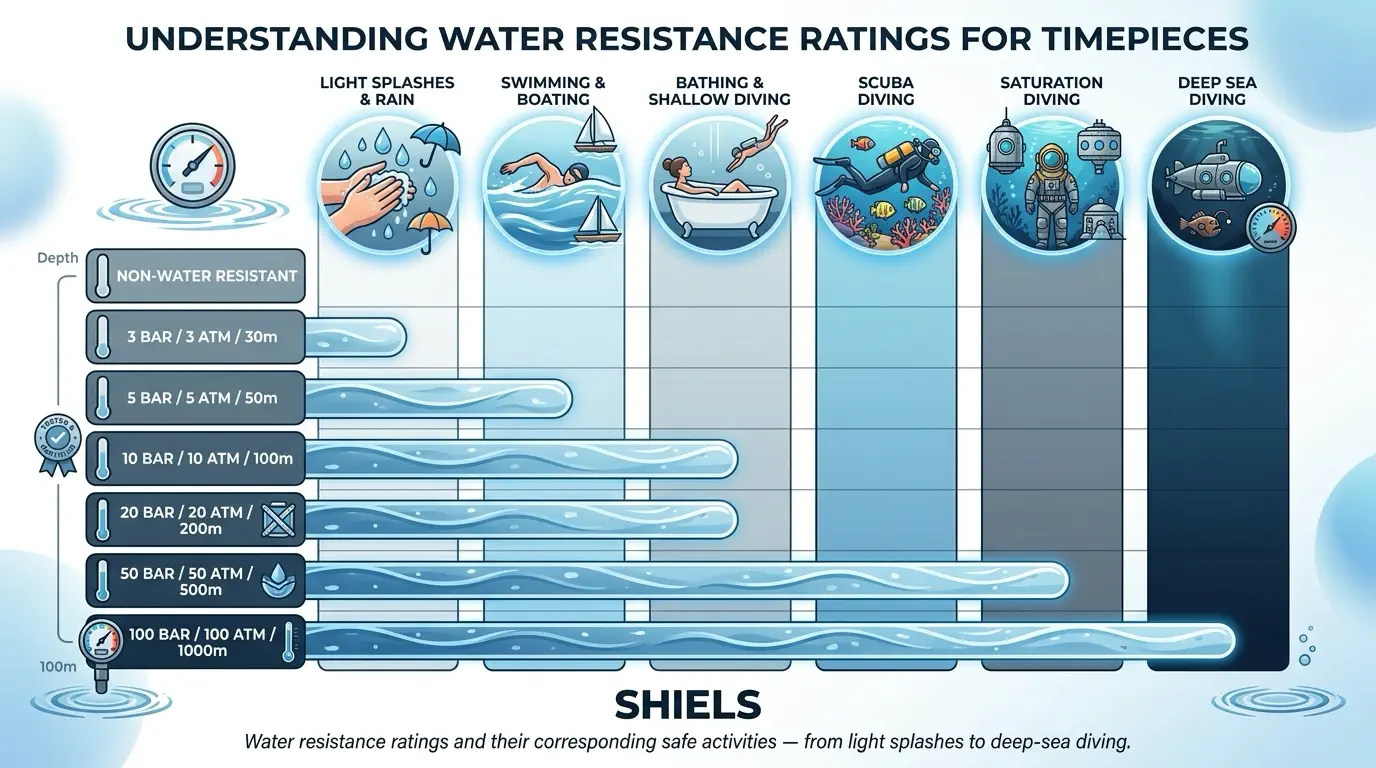
The Rating Spectrum
From everyday elegance to professional saturation diving, each rating tier serves a distinct purpose. Here is how to interpret every level.
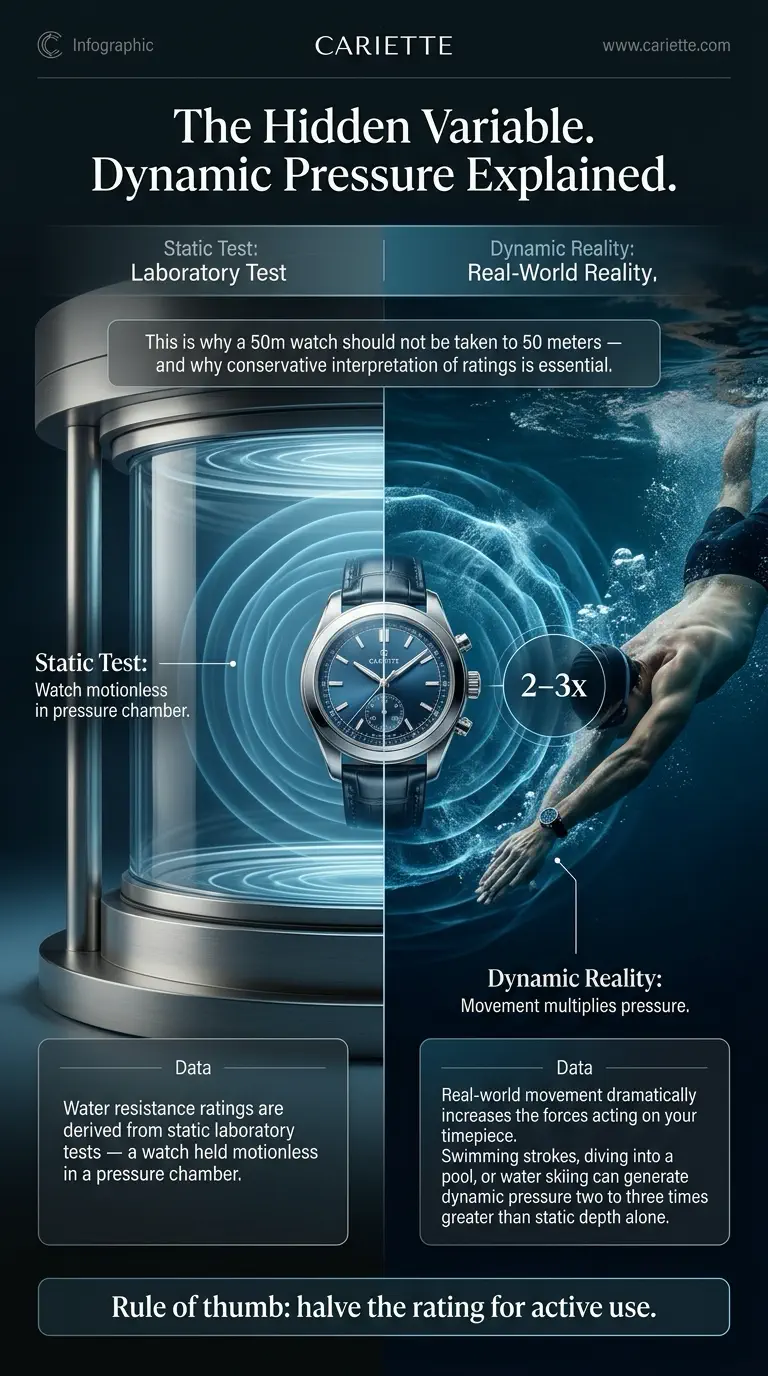
The Hidden Variable
Dynamic Pressure Explained
Water resistance ratings are derived from static laboratory tests — a watch held motionless in a pressure chamber. Real-world movement dramatically increases the forces acting on your timepiece.
Swimming strokes, diving into a pool, or water skiing can generate dynamic pressure two to three times greater than static depth alone. This is why a 50m watch should not be taken to 50 meters — and why conservative interpretation of ratings is essential.
- Static test: watch motionless in pressure chamber
- Dynamic reality: movement multiplies pressure
- Rule of thumb: halve the rating for active use
The Anatomy of Water Resistance
Gaskets & Seals
Rubber, silicone, or cork gaskets at the case back, crystal, and crown form the primary barrier. These degrade over time and require replacement every 2–3 years.
Screw-Down Crown
Threads the crown into the case, compressing the gasket for an airtight seal. Essential for any watch intended for submersion. Always verify it is fully locked before water exposure.
Case Construction
Monobloc cases and screw-down case backs eliminate entry points. The precision of machining and quality of materials directly determine pressure tolerance.
Helium Escape Valve
Found on professional dive watches. Releases built-up helium atoms during decompression to prevent crystal displacement — a feature pioneered by Rolex in 1967.
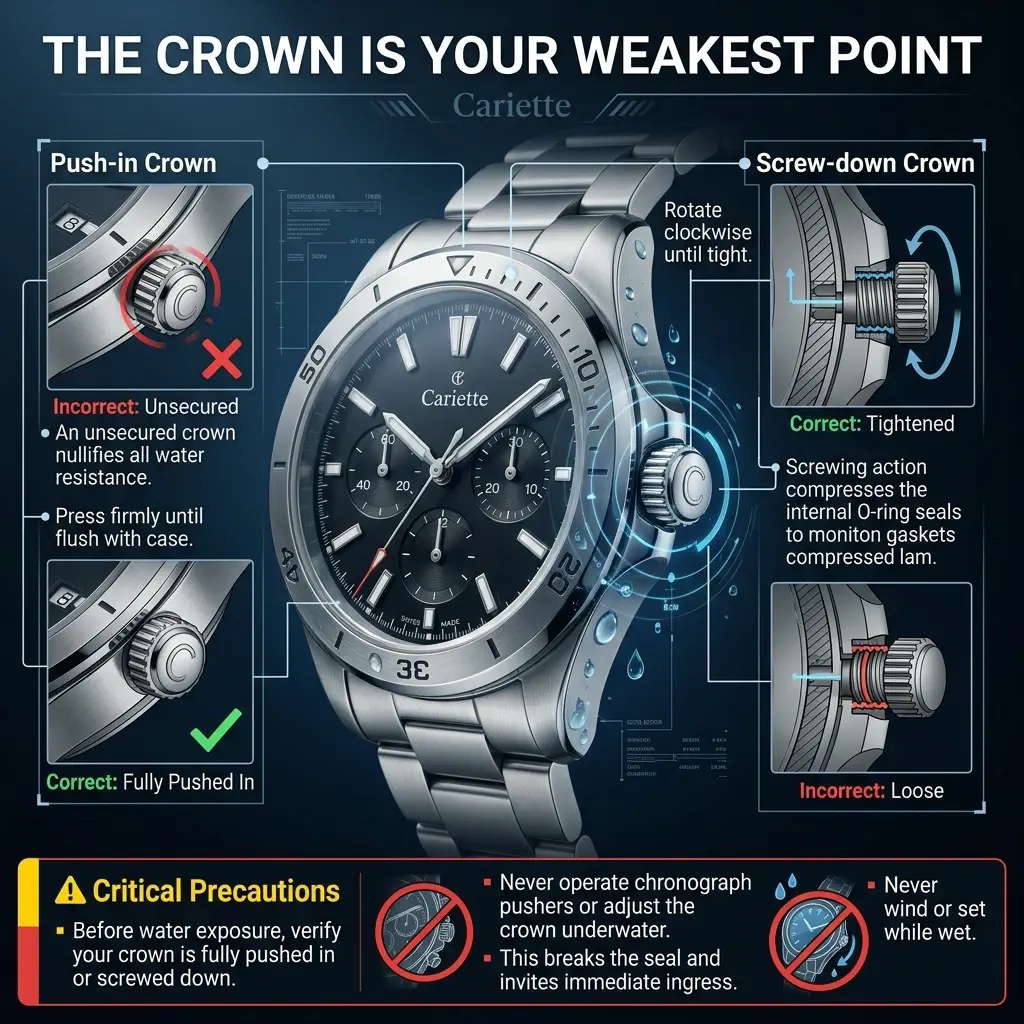
Critical Detail
The Crown Is Your Weakest Point
An unsecured crown nullifies all water resistance. Before any water exposure, verify your crown is fully pushed in or screwed down. Never operate chronograph pushers or adjust the crown underwater — this breaks the seal and invites immediate ingress.
- Push-in crown: press firmly until flush with case
- Screw-down crown: rotate clockwise until tight
- Never wind or set while wet
Preserving Your Investment
Water resistance is not permanent. Seals degrade, gaskets compress, and cases can warp. Proactive maintenance is the only way to ensure your rating remains valid.
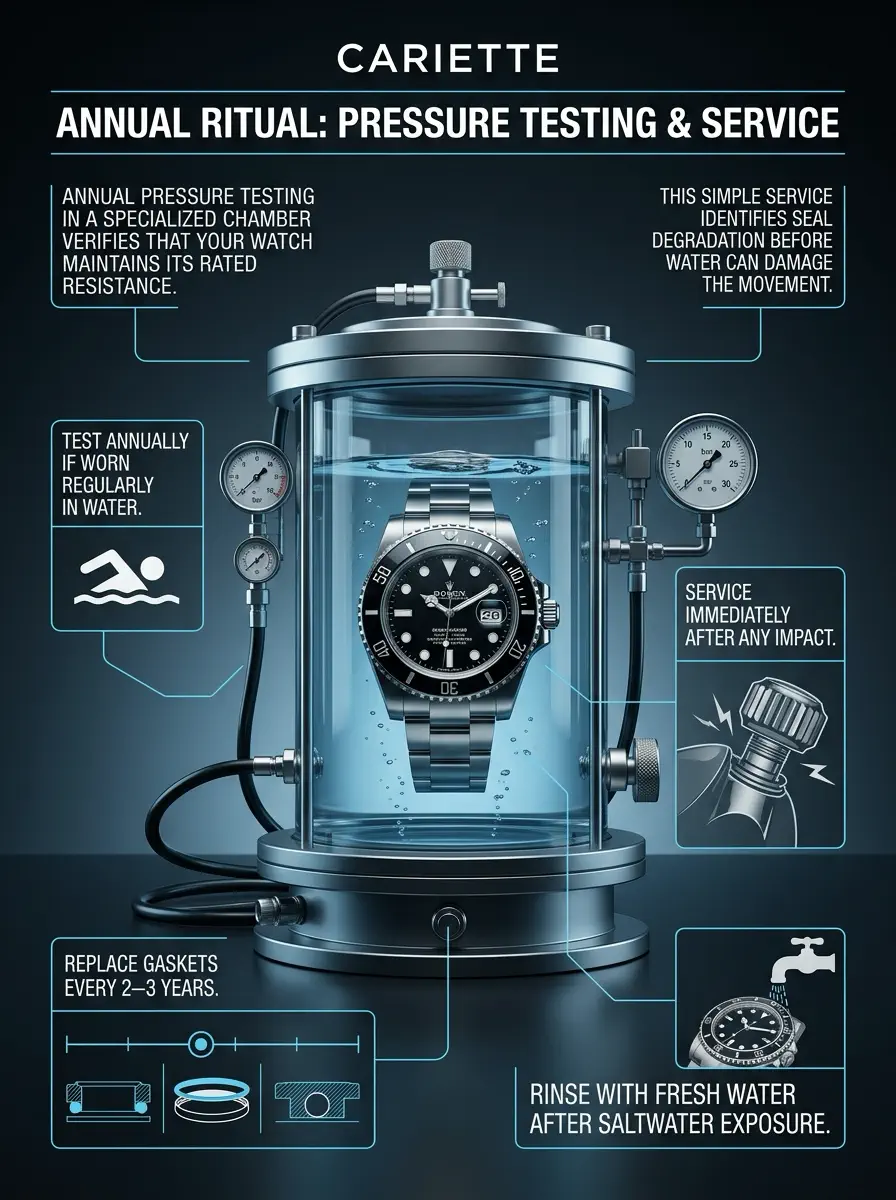
Annual Ritual
Pressure Testing & Service
Annual pressure testing in a specialized chamber verifies that your watch maintains its rated resistance. This simple service identifies seal degradation before water can damage the movement.
- Test annually if worn regularly in water
- Replace gaskets every 2–3 years
- Service immediately after any impact
- Rinse with fresh water after saltwater exposure
What Damages Water Resistance
Hot Water & Steam
Saunas, hot tubs, and hot showers cause gaskets to expand and contract, creating entry points.
Saunas, hot tubs, and hot showers cause gaskets to expand and contract, creating entry points.
Soap & Chemicals
Shampoo, soap, and perfume corrode rubber seals and degrade case finishes over time.
Shampoo, soap, and perfume corrode rubber seals and degrade case finishes over time.
Sudden Impact
Diving into water or dropping your watch can warp cases and dislodge crystals instantly.
Diving into water or dropping your watch can warp cases and dislodge crystals instantly.
Age & Neglect
Gaskets naturally harden and crack. A 10-year-old watch without service has no guaranteed resistance.
Gaskets naturally harden and crack. A 10-year-old watch without service has no guaranteed resistance.
Discover Water-Ready Timepieces at Cariette
Explore our curated collection of watches — from elegant dress pieces to professional dive instruments, each selected for exceptional engineering and enduring style.
Shop WatchesFrequently Asked Questions
Can I shower with my 50m water-resistant watch?
Technically, 5 ATM (50m) watches can withstand shower spray. However, hot water, steam, and soap chemicals accelerate gasket degradation. For daily shower wear, 10 ATM is the safer threshold. If you choose to shower with a 50m watch, rinse it with fresh water afterward and have it pressure-tested annually.
Why can't I swim with a 30m watch?
3 ATM (30m) is rated for static pressure only — essentially, humidity and accidental splashes. The dynamic forces generated by swimming strokes, water entry, and arm movement can exceed this rating within seconds. Water ingress at this level is common and often irreversible.
How often should I have my watch pressure-tested?
Annually for watches regularly exposed to water. Every 2–3 years for occasional water contact. Always test after any impact, battery replacement, or service that required opening the case. Reputable watchmakers use vacuum or pressure chambers to verify seal integrity without submerging the watch.
Does water resistance affect my watch's warranty?
Most manufacturers void water-damage claims if the watch was used beyond its rated capacity, if the crown was unsecured, or if recommended service intervals were ignored. Always retain service records and pressure test certificates to support warranty claims.
What is the difference between ATM and IPX ratings?
ATM (atmospheres) is the traditional horology standard based on water pressure depth. IPX (Ingress Protection) is an IEC standard used primarily for electronics and smartwatches. IPX7 means submersion to 1 meter for 30 minutes; IPX8 means deeper submersion per manufacturer specs. For swimming, 5 ATM is generally more reliable than IPX7 because it accounts for dynamic pressure.